
DeepSeek V4.1 Flash Is Live: Faster, Cheaper, Multimodal - and What You Actually Need to Change
Three Announcements in Three Days
DeepSeek moved faster this week than most labs do per quarter. On September 8 an interim build appeared under the model id deepseek-v4.1-flash-expires-on-0910 - a two-day stress test with the expiry baked into the name. On September 9 the open-platform notice promised a formal release with Pro-tier claims. On September 10 the release landed with a new Flash price card and a routing change nobody saw coming: until V4.1 Pro ships, every request to deepseek-v4-pro is served by V4.1 Flash at Flash prices. The endpoint name stays; the model underneath changes.
If you run inference workloads on rented GPUs or front them with an OpenAI-compatible gateway, this is the practical read.
The Numbers DeepSeek Published (and What They Mean)
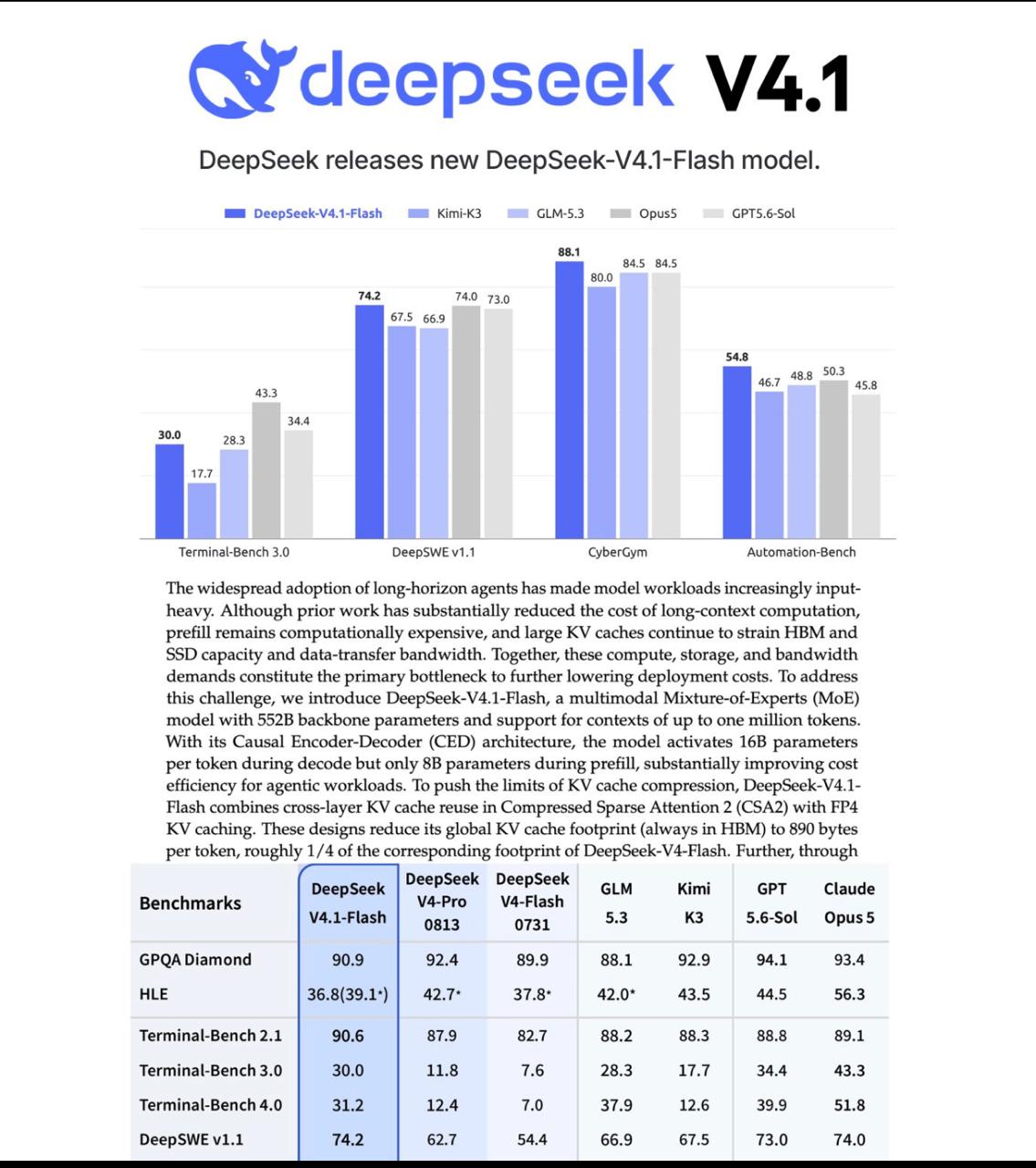
DeepSeek's release graphic leads with four agentic benchmarks against Kimi K3, GLM 5.3, Claude Opus 5 and GPT 5.6-Sol. Vendor-reported, from DeepSeek's own runs - label them accordingly in anything you quote:
| Benchmark | V4.1 Flash | V4-Pro 0813 | V4-Flash 0731 | GLM 5.3 | Kimi K3 | GPT 5.6-Sol | Claude Opus 5 |
|---|---|---|---|---|---|---|---|
| GPQA Diamond | 90.9 | 92.4 | 89.9 | 88.1 | 92.9 | 94.1 | 93.4 |
| HLE | 36.8 (39.1*) | 42.7* | 37.8* | 42.0* | 43.5 | 44.5 | 56.3 |
| Terminal-Bench 2.1 | 90.6 | 87.9 | 82.7 | 88.2 | 88.3 | 88.8 | 89.1 |
| Terminal-Bench 3.0 | 30.0 | 11.8 | 7.6 | 28.3 | 17.7 | 34.4 | 43.3 |
| Terminal-Bench 4.0 | 31.2 | 12.4 | 7.0 | 37.9 | 12.6 | 39.9 | 51.8 |
| DeepSWE v1.1 | 74.2 | 62.7 | 54.4 | 66.9 | 67.5 | 73.0 | 74.0 |
(*Alternate evaluation configuration - DeepSeek's own footnote convention.)
Read this table the way an operator should:
- The headline is legitimate: +90.6 on Terminal-Bench 2.1 (up from 82.7 for 0731), and DeepSWE 74.2 puts the Flash tier within 0.2 of Claude Opus 5. For agent-and-code traffic - most of what a hosting shop actually routes - the Pro-replacement claim has real numbers behind it.
- The honest caveat is in the hard rows: on Terminal-Bench 3.0/4.0, Opus 5 and GPT 5.6-Sol still lead by double digits (43.3/51.8 vs 30.0/31.2), and HLE shows Claude at 56.3 vs 36.8. "Comprehensively surpasses Pro" is true against DeepSeek's Pro on these tasks; it is not the same as beating frontier closed models at the hardest agentic work.
- The intra-family jump is the efficiency story: on Terminal-Bench 3.0, V4-Pro 0813 scored 11.8 and 0731 Flash scored 7.6; V4.1 Flash nearly triples that to 30.0. New pre-training plus bigger RL post-training, not a fine-tune.
What Changed Under the Hood
Reported architecture: a 552B-parameter MoE with a causal-encoder-decoder structure - asymmetric by design, with 8B active parameters on the input side and 16B on the output side. That asymmetry is the cost story: prefill (reading your prompt) is cheaper than decode (writing the answer), and this architecture formalizes it.
The number that matters for GPU capacity planning is the KV cache. DeepSeek claims HBM demand for cache dropped to a quarter of the previous generation (SSD demand to an eighth). Cache is what makes long-context serving expensive on rented H100/H200 boxes - a 4× reduction means the same node serves dramatically more concurrent long-context sessions, or the same sessions on cheaper cards. That is a vendor number; treat it accordingly, but note that DeepSeek also productized the claim by cutting the price of cached reads, which is the kind of bet a vendor only makes when the infra actually moved.
Native multimodal: image input is now in the base Flash model - no separate vision build. The old bolt-on (deepseek-v4-flash-vision-exp) is deprecated; its old model ids currently route to V4.1 Flash.
The Price Card Is the Headline
New Flash-series rates (off-peak, per million tokens; peak is exactly double, weekdays 01:00-04:00 and 06:00-10:00 UTC):
| Line | Before | Now | Change |
|---|---|---|---|
| Input, cache hit | $0.007 | $0.003 | −57% |
| Input, cache miss | $0.22 | $0.15 | −32% |
| Output | $0.66 | $0.60 | −9% |
The cut is steepest exactly where agent workloads live: cached input. An agent loop re-reads its context every turn - cache hits are most of the bill - and a 57% cut there compounds across every turn. For comparison, V4 Pro's old off-peak rates were $0.022 cached / $0.66 uncached / $1.98 output, so anyone whose Pro traffic is now transparently served by Flash is seeing a 70-86% bill reduction without touching code.
Speed, per community measurement (not vendor, not controlled): sustained ~300-500 output tokens/s, against 120-140 tok/s measured on V4 Flash 0731. One caveat people keep missing: at per-token pricing, a model 2-3× faster drains your balance 2-3× faster per minute. Per-task cost only falls if the model finishes with fewer tokens and fewer retries - unproven this week.
What Is Not Proven Yet
Say it plainly before anyone pastes this into a budget doc:
- No independent benchmark scores. DeepSeek published its own table (above); Artificial Analysis and the usual boards had not independently measured the release build at publish time. The table's own rows already concede the frontier gap on Terminal-Bench 3.0/4.0 and HLE.
- No published model card, technical report, or concurrency ceiling for the release build (the old Flash listed 2,500 concurrent; 4.1's number is unannounced).
- No weights. V4 Flash 0731 is MIT-licensed and self-hostable; nothing has been announced for 4.1. If your compliance posture depends on running the weights yourself, that argument is over until they ship.
- It is a re-trained model, not a refresh. New pre-training run per several outlets - prompting quirks, tool-calling style and refusal edges can shift even where capability does not. Prompts tuned against 0731 need regression-testing, not a model-name sed.
Adopting It Through a Gateway
Because the release keeps the OpenAI-compatible wire format, adoption through an OpenAI-compatible aggregator like IndieRouter is a model-name change:
resp = client.chat.completions.create(
    model="deepseek/deepseek-v4.1-flash",   # name may vary by gateway
    messages=[{"role": "user", "content": [...]}],
)
The disciplined rollout, given the unproven list above:
- Pin, don't float. Explicitly target
deepseek-v4.1-flash- do not rely on the temporary routing ofdeepseek-v4-prointo it. Routing is a vendor decision that changes when V4.1 Pro ships; if your budget assumed it, your prod silently swaps engines again in a few weeks. - Split traffic, keep a failover. New workloads go to 4.1 Flash; the workload that pays your bills stays on V4 Flash 0731 (the build with a month of receipts and open weights) until third-party scores land. A gateway makes this a routing rule, not a migration.
- Regression-test tool-calling. Run your existing eval suite - at minimum the agent loop that uses your tools - before promoting. A re-trained model is a behaviour change.
- Watch the peak windows. Double pricing during 01:00-04:00 and 06:00-10:00 UTC weekdays. Batch jobs, backfills and re-embed passes that don't need to finish in a human's morning should be scheduled or queued to land off-peak. If your gateway supports it, shape or delay bulk traffic against that window.
- Cap concurrency per key. The beta's 20-concurrent cap is gone with the beta id, but the release ceiling is unpublished - set your gateway limits from the old Flash number, not hope.
What This Does to the Self-Host Math
Every generation, DeepSeek compresses more capability into less HBM and prices the API as if they want the third-party inference market to keep shrinking. A quarter of the KV-cache footprint is a real win for people running vLLM on rented H100s - but only if/when weights ship. Until then the honest position:
- API path: V4.1 Flash through your gateway, at these prices, is the strongest Flash-tier deal on the board. Take it for new workloads today.
- Self-host path: stays on V4 Flash 0731 (MIT weights) until DeepSeek announces weights for 4.1. If they don't, this release quietly becomes an API-only product - and the case for open-weight models in your stack gets stronger, not weaker.
We will publish measured throughput, cache-hit economics and tool-call evals from our own GPU nodes once the model lands on our inference stack - including the number that actually decides this: tokens-per-dollar-per-task against 0731.
The One-Line Version
Cheaper cache, native vision, genuinely faster, Pro-grade claims you cannot yet verify, and a vendor quietly routing its premium tier to the cheap model. Point new workloads at it through your gateway, keep 0731 as failover, and do not let a price table into your budget before an independent scorecard exists.